
Informing the world leaders of measures taken by him, Modi said India will continue to accord a high national priority to nuclear security through strong institutional framework, independent regulatory agency and trained and specialised manpower.
In a late-night tweet in capital letters, he said Iran must 'never, ever threaten the United States again'.

Obama seeks reduction of nuclear arsenal in India and Pakistan while Pakistan seeks NSG membership
At scaling back Tehran's nuclear programme and relieving the Islamic Republic from the sanctions

An India-Japan joint statement said the two leaders expressed serious concern over the conflict and the unfolding humanitarian crisis in Ukraine.

The biological weapons convention is a non-starter in spite of the efforts of many states in the world for the last five decades mainly because the US is not ready to accept the 'verification protocol' which could allow the formation of some official mechanism for inspections, says Ajay Lele.

He said the US will apply other punitive measures if Tehran does not give up its reported goal of developing nuclear weapons.

It's time India re-visited its Western alliances for the attitude and approach that the West reserves for the nation when it comes to security cooperation of the kind that they might not have visualised outside of China, India's bug-bear, asserts N Sathiya Moorthy.
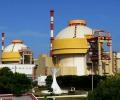
'Decisions on nuclear power have so far been taken by a small select group, primarily interested in profiteering from their actions, stating 'secrecy' as necessary from the national security point.' 'This argument is false, because we are dealing with the 'civilian' nuclear power sector, which is open even to the IAEA,' says Dr A Gopalakrishnan, former chairman of the Atomic Energy Regulatory Board.

Leaders of the two countries, however, did discuss on Pakistan's nuclear safety and security which is an ongoing discussion.
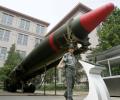
Despite four disarmament section talks and six strategic dialogues between the two foreign ministries, China's intransigence on recognising Indian nuclear status resulted in no confidence building measures in the nuclear field between the two, says Srikanth Kondapalli.
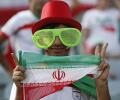

Prime Minister Manmohan Singh on Friday batted for nuclear power as a "dependable and clean option", even as he underlined the need to ensure that all ingredients by which nuclear fuel is made remain safe and do not fall in the hands of terrorists and anti-social elements.
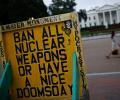
After 20 months of hectic negotiations, Iran and six major powers have reached a historic deal to limit Teheran's nuclear programme in return for lifting of sanctions. Let's understand closely what the deal is all about.
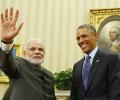
With their landmark 2005 civil nuclear deal still in limbo, India and the United States have established an inter-agency contact group to sort out outstanding liability and technical issues to fast-track its full implementation.
Former media advisor to Prime Minister Manmohan Singh Dr Sanjay Baru, the author of the controversial book 'The Accidental Prime Minister' that put Dr Singh in the dock over his alleged unassertiveness on policy issues, however points out that it was during the Indo-US nuclear deal discussions that the prime minister put his foot down and even staked his political future 'for the honour of commitment'. Bikash Mohapatra reports.

BWith a distracted president brooding in the White House, Pompeo seems to think his day has come. He seems to be pushing a personal agenda before a target audience in America, observes Ambassador M K Bhadrakumar.
Iran is preparing for a trade and investment boom that could reshape the region after agreeing with world powers to curb its nuclear programme, paving the way for sanctions that have stifled its economy to be lifted.
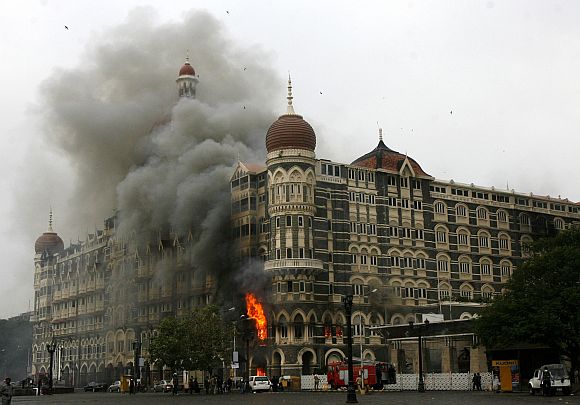
'Headley's testimony indicates to what extent the Pakistan government and its proxies can go to destroy not only Indian scientific talent but also international expertise.'

'I would urge my Indian friends to look at how significant the overall support was.'

'The biggest lacuna in this agreement is it is called 'full civil nuclear cooperation agreement.' Actually, it is anything but full.'

Prime Minister Narendra Modi and United States President Barack Obama will meet on Sunday, January 25, at Hyderabad House a few hours after the American leader's arrival in New Delhi.

The joint statement issued after Prime Minister Narendra Modi and President Barack Obama's first-ever summit is high on intent and ambition. Notably missing from the statement is India's refusal to be America's partner in its war against ISIS.

Although the pact would focus mainly on the Pacific and the South China Sea region, any action designed to deter China with or without New Delhi's active participation is a welcome move, notes Commodore Venugopal Menon (retd).

The powerful United Nations Security Council on Monday unanimously adopted a resolution that endorses the landmark nuclear deal between Iran and six world powers.
'If we could break through this symbolic barrier of sanctions and a dysfunctional relationship, we could do anything.'

'He always had a choice to resign and walk toward the sunset in protest.' 'Instead, he chose to be a mute witness to one of the most sordid chapters of India's parliamentary history when MPs were bought up like cattle to steer the nuclear deal through,' says M K Bhadrakumar.

The agreement was reached in intensive negotiations between contact groups that Obama and Modi had set up in September.

If these reports are true, it means that it possesses something much more powerful than it has tested in the past. North Korea has run nuclear tests in the pasts, but this announcement has sent panic waves internationally.

India has a 'natural global partnership' with US, says PM.

To imagine that no one contributed to global peace to deserve the prize in 2017 is to be extremely cynical about peacemakers around the globe.

'The onus is now on China to explain to the world why it feels Pakistan should accompany India on the question of NSG Membership!! China's not so covert help for Pakistan's nuclear weapons and ballistic missile programmes will stand exposed,' says former ambassador G Parthasarathy.

Two decisions handed down by the Supreme Court have spread gloom in Kerala as they have shaken two basic faiths of a majority of the people in the state, says T P Sreenivasan.

'From envy, heartburn and broken hearts to broken marriages, much damage has been done by unintended revelations in the social media. Suspicious partners bring out hidden relationships, which may never have come to light and hell breaks lose in many lives,' warns T P Sreenivasan.
'Unlike Japan and China, the US has a long relationship with India. He is going there to fly the Indian flag in a gesture of friendship. This is a journey like none other, meant to signal that the two democracies are in a defining relationship of the 21st century.'

'Castro told us: "Give me a thousand Gurkhas and I shall keep my neighbour under control!"' 'We pretended that we did not know which neighbour he meant.'

'If ever India loses its patience after repeated terror attacks and decides to retaliate against the terrorist camps, Pakistan may term that a conventional military attack and invoke the nuclear option. This is a way to continue with terrorism without retaliation.'

Negotiating a sustainable compromise with Iran is not getting any easier, and this delay might not yield the desired result of bringing Tehran's nuclear programme under stringent limits, says Claude Smadja

It is unconscionable to choose between Sardar Patel, who united India physically, and Indira Gandhi, who gave meaning, content and pride to the unity of the nation and became a martyr at the altar of national unity, says Ambassador T P Sreenivasan.

PM Modi seems to be gradually ending India's strategic ambiguity
